For makers By Rade Kolbas8 November 20265 min read
We said no to hundreds of products.Here's why.
More than half of what people send us never becomes a listing. What we turn down, why, and the grey areas where we still say yes, for makers who want to get it right and readers who want to know what a listing here means.
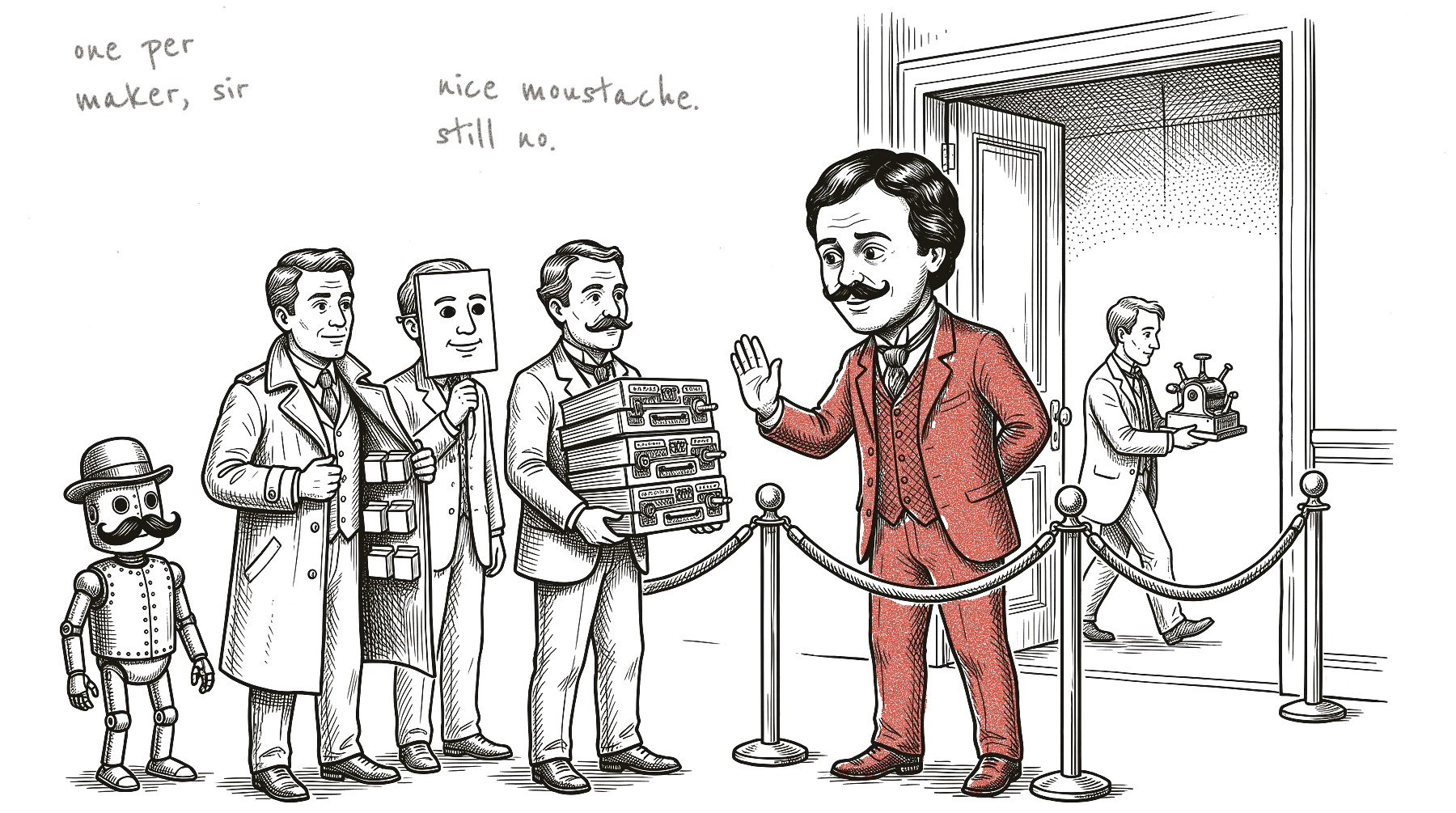
One day, a single sender submitted sixteen websites, all named after other companies’ AI video models. That’s the far end of what lands at SaaSolution, the free directory of new software I run. Several dozen products arrive on a quiet day, more on a busy one, and every site gets visited before it becomes a listing or a no.
More than half of everything we’ve received never became a listing. Solo makers and products with ugly websites get in all the time, so the bar sits somewhere else: a free directory only works if a listing means something. Here is what we turn down and why. If you build software, there’s a short checklist at the end, and you can send us your product through the submit page.
Most no’s are boring
The most common reason is plain repetition. The same product arrives two to four times. One maker sent eight products that all live on one website, and we list one product per site. Some sites also come back unchanged after a no.
Then there are sites that aren’t ready yet: a sign-up link that leads nowhere, empty pages, a closed beta that needs an invite, a prototype running on made-up data. Those makers are welcome to send it again once real people can use it, because for them the answer is “not yet”.
Websites that come in batches
Hundreds of submissions arrive in series: one sender, many near-identical sites, often on the same day. Besides the sixteen above, others sent dozens of “AI trend video” generators over a few weeks, each on a slightly different domain.
A site named after someone else’s AI model, with a shop for usage credits on top, is usually there to catch people searching for that model’s name. We treat these as bots and ignore them.
It has to be software, and some of it has to be yours
Dozens of submissions are something else in a software costume: an agency whose “AI agents” are custom projects you get after a sales call, a single calculator page that exists to sell a spreadsheet, a print shop whose “photo tool” is the order form for a canvas. They may be good businesses, but our readers come here for software.
Building on another company’s AI model is normal, and we list plenty of products that do it well. I want to see work of your own on top: a photo app that turns any picture into one fixed style, say, or a tool that checks and edits what the AI wrote before you see it. The bare version gets turned down: a menu of other companies’ models, a credit balance and a new logo. One “all-in-one studio” resold more than 160 models that way.
Paid rankings and backlink shops
Every listing here is free, and every product gets the same treatment. So we don’t list directories or “leaderboards” that sort products by how much the makers paid, or services that sell backlinks, which are links from other websites bought to push your site up in Google.
Taking what isn’t yours
This is one of the bigger groups, and the one I feel strongest about:
- Face swap and voice cloning without the person’s consent, including when it sits in a side tab of an otherwise harmless photo app.
- “Viral trend” clips that put your face into a copied dance, with the original song and no music licence.
- Downloaders for other people’s videos and music.
- Copies of other people’s work. One was a rebranded open-source PDF tool with the original author’s payment link still in the code.
- Fan tools built on big game brands, and app names one letter away from a famous one.
AI that hides it’s AI
I’m happy to list AI products as long as the machine is open about being one. The ones built to hide it stay out: AI phone receptionists that don’t tell the caller at the start of the call, tools that remove the “Made with AI” label before you repost a picture, and “humanizers” that disguise AI-written text. Several products that were otherwise decent failed on one of these features alone. When a feature like that is the whole point, the product stays out. When it’s a small extra, we sometimes list the rest and leave it out of the description.
Spam and money promises
A few more we see often enough to name:
- Email tools that write to strangers on autopilot, from domains bought just for that.
- Services for running many fake accounts on social platforms without getting caught.
- People-search sites with a page about each private person.
- Apps that only accept crypto, even harmless ones, and trading signals promising an average monthly return of 47%.
Two kinds were rare, but they stuck with me: a homepage showing another company’s customer quotes with the product name swapped in, and a generator for fake comment screenshots, sold to make ads look popular. Copying someone’s customer quotes is on the EU’s list of practices that are always unfair:
“misrepresenting consumer reviews or social endorsements, in order to promote products”
EU Unfair Commercial Practices Directive, list of practices that are always unfair
The US has a similar rule. Since October 2024, the Federal Trade Commission bans writing, creating or selling fake reviews and testimonials.
Where I still say yes
Some cases sit in between, and this is where I still say yes:
- A rough site gets in if the product works. Extra pages written for Google, or no company name on the site, don’t stop a listing. The listing describes what’s there.
- Voice AI gets in when it’s clear a machine speaks, and so does voice cloning from a sample the person agreed to.
- Crypto can be one option inside a proper payment provider, as long as there is another way to pay.
- Competitors are welcome, including other directories, as long as they don’t sell ranking.
Every listing, these included, describes what a site says it does and stops there. It’s never a recommendation.
If you’re about to submit your product
From where I sit, this gets a quick yes:
- One product per website, sent once.
- A site that works today, not next month.
- No borrowed logos, quotes or numbers you can’t back up.
- If AI talks to people, it says so.
- You sell your product, not rankings and not other people’s faces or voices.
Most makers already do all five without being told. The “more than half” at the top comes in large part from duplicates and a small number of senders with whole batches of sites, which makes this post about the few who don’t.
Sources
- Our own review notes, October to November 2026
- Directive 2005/29/EC (Unfair Commercial Practices Directive), Annex I, point 23c, added by Directive (EU) 2019/2161
- FTC, Trade Regulation Rule on the Use of Consumer Reviews and Testimonials, 16 CFR Part 465, effective 21 October 2024