For makers By Rade Kolbas30 October 20268 min read
Your big customers aren't saying no.They're just not saying anything.
Deals with large companies seem to be getting stuck. I looked at what the data shows, what is really slowing decisions down, and where I think AI comes in.
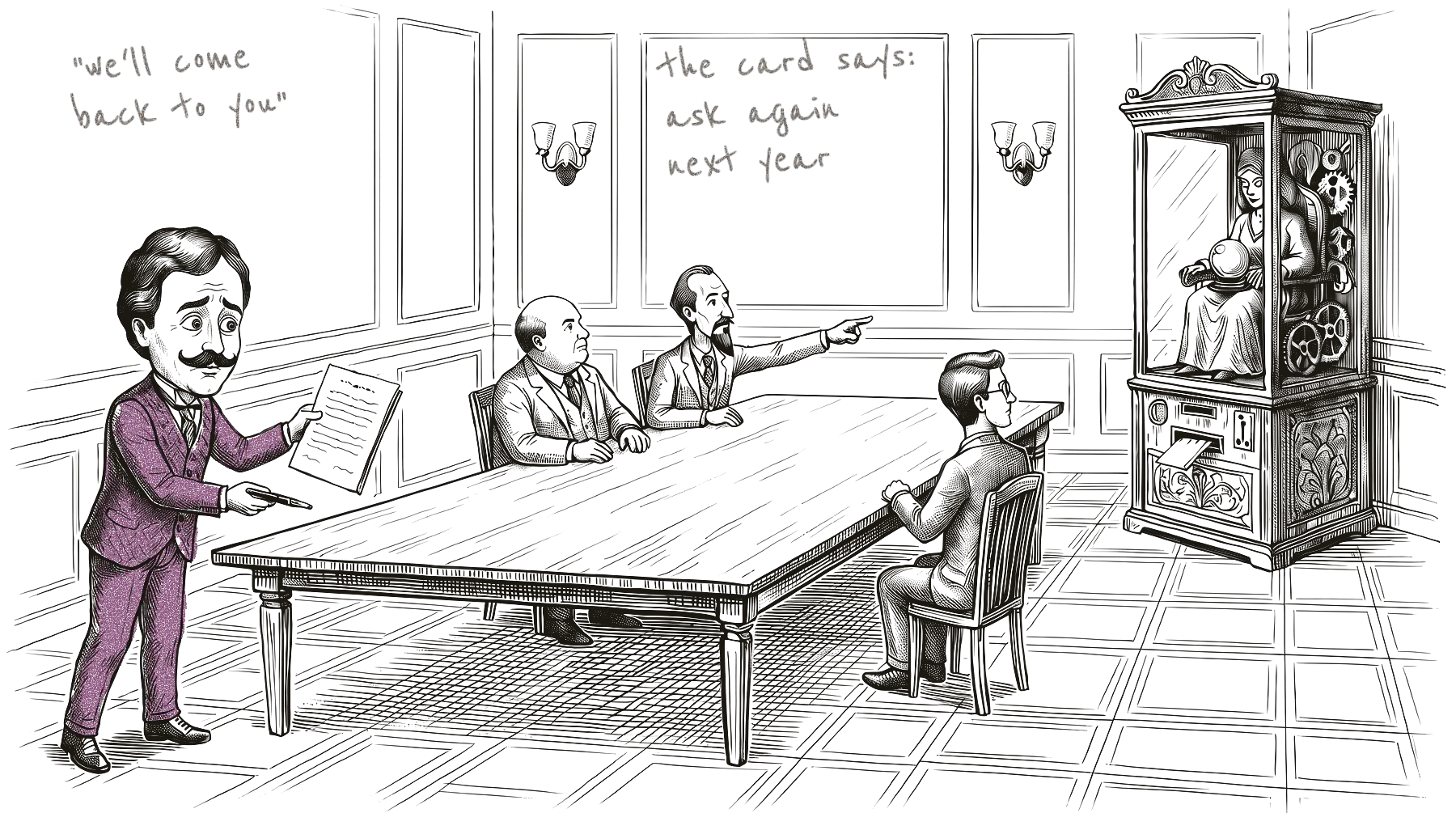
The demo went well. People nodded, somebody said “this is exactly what we need”, and you left the meeting already spending the money in your head. That was four months ago. Your last two emails got a friendly “we’ll come back to you”.
If you sell software to big companies, you may know this feeling and have started to wonder what you did wrong. Maybe your product is the problem, or your price, or you.
Maybe. But I’d look at the bigger picture before you rebuild everything out of panic. After reading through the numbers, I think part of this has nothing to do with you. I also suspect AI plays a role, and I’ll tell you where I’m guessing. At the end you’ll find what I would do about it.
Is it really taking longer? Nobody can say for sure
The time it takes to close a deal is called the sales cycle, and the figures on it disagree with each other.
They clearly got longer in 2022 and 2023, by 32% and then 16%, according to reports from the sales data firm Ebsta and the network Pavilion. Interest rates were shooting up and companies were laying people off. That slowdown began before ChatGPT even came out.
The most recent numbers point in different directions. A 2026 report from Fullcast and Pavilion looked at 361,000 possible deals and found cycles about 7% longer, probably comparing 2025 with 2024. Gong, which sells AI tools to sales teams, says they stayed about the same in 2025. For 2026, I found no solid figures at all. If someone gives you one number for how much slower deals have become, ask which report it came from.
Salespeople’s own impression is clearer. In Salesforce’s 2026 report, 57% of 4,050 sales professionals said customers take longer to decide than they used to. That is across all industries, and it’s what they feel, not what anyone measured.
Big deals may have it worse, but I can only offer hints. Five9, which makes call center software, reported longer cycles on larger deals in 2025. IBM said large deals slipped from one quarter to the next in 2026, and about two-thirds of them then closed. Its CEO called it “a timing question, not a destruction question”, meaning delayed, not lost.
The money isn’t gone, but more people are guarding it
In Gartner’s 2026 survey of about 1,100 IT chiefs, 43% reported rising budgets, 38% flat and 19% falling. So the money hasn’t simply disappeared.
Getting it out seems harder, though. G2, a software review site that sells to software vendors, surveyed 1,038 buyers in June 2026. Finance departments were involved in 46% of software decisions, up from 31% a year earlier. And 49% said their finance chief had stopped an already approved purchase in the past 12 months.
Those stopped purchases were more common at companies with a separate budget for AI models: 54%, against 29% at companies without one. One survey can’t show cause and effect, so I’d read this as a hint that AI bills are competing with your invoice.
The firms I read mostly blame the world
When large software and IT services firms explain slow deals to investors, they rarely name AI:
- Infosys said in October 2026 that in manufacturing, the Middle East conflict, inflation and tariffs are squeezing optional spending and “extending decision cycles”.
- SAP blamed the tariff debate for slow bookings in the first half of 2025.
- Accenture linked longer decisions in Europe, the Middle East and Africa to the Middle East conflict in June 2026.
A US survey of company finance chiefs from September 2026 lists interest rates and inflation as top concerns, and AI isn’t on that list, though it covers all kinds of firms and doesn’t ask about buying software.
Blaming the world is also the most comfortable explanation an executive can give, so I wouldn’t take it as the whole story.
I think AI is in the room, and I can’t prove it
Imagine you run IT at a large company. Someone offers you a good solution to a real problem, and you could sign. But for years you have heard that AI will soon replace your staff and run your company. Why commit to a long contract now, if next year your own people might build the thing themselves? Waiting feels safe, because nobody gets fired for it.
I think that thought sits in a lot of heads, though I found no survey that asks the question directly. One CEO came close to saying it out loud.
“we saw a trend of AI and agentic confusion in our customer conversations”
Henry Schuck, CEO of the sales data company ZoomInfo, May 2026
“Agentic” means AI programs that carry out tasks on their own. Schuck said customers were asking what can be built and what should be bought, and that this led to a pause in purchasing decisions, especially among his software customers. He called it temporary and also named a weaker economy. And it’s one company.
Others disagree with me. The CEO of the IT services firm Infosys, asked about clients taking IT work back in-house, said “we do not see a pattern that more in-sourcing is happening because of the AI”. The CEO of Workday, which sells HR and finance software, says he hasn’t met a single customer who wants to replace it with something built internally. Both have every reason to say that, and the same goes for people selling AI.
Two famous stories also shrink when you read the details. The CEO of the payments company Klarna told investors he had shut down Salesforce, the big customer management software, and many read that as AI replacing it. In 2025 he wrote: “we did not replace SaaS with an LLM”. SaaS is software you rent online, and an LLM is the kind of AI model behind chatbots. The company had rebuilt how it handles its data instead.
Bloomberg reported in 2026 that Starbucks is building its own replacements for some software, which could launch by the end of 2027. So far its tech team is on track to trim about $10 million from a software bill of about $400 million a year, which is a small part.
I replaced Adobe. I wouldn’t replace your audit trail.
I understand why people hope to build it themselves, because I’ve done it. For my book business I replaced the whole Adobe suite with tools I built for what I do: putting a book together, making covers. It works very well, and it has made me more successful. I also looked at a vibe-coded Adobe clone, meaning one built by telling an AI what you want, and it was full of bugs and barely worked. My tools work because they only have to do my job, for one user, who is me.
A big company is in a different place. It may need an audit trail, a record of who changed what and when. It may have to answer to regulators, or have hundreds of people who depend on data moving cleanly between two systems. I wrote about what running such software means in my last post.
And I wonder how many of those waiting know the difference yet. In my own field I’m shocked at how many mistakes AI makes. Outside it, everything looks right to me, because I can’t judge it. A demo can look just as perfect to someone who has never had to run the thing.
If I were selling to big companies now
- Plan for slow deals. If you are small and counting on one large contract, assume it takes longer than you hope, and check how long your money lasts.
- Write for the person who isn’t in the room. Finance can stop a deal you thought was done. Give your contact one page with what the problem costs them today, what changes, and how they would measure it.
- Answer “why not build it ourselves?” before they ask. Be concrete about what is hard to copy: years of odd special cases, security, audits, someone who answers at night. If your answer is “you could build this in a week”, you should know that before they do.
- Make the first step small. Forrester says more than 60% of business buyers now use a trial. A paid pilot with one team is also easier to approve, I think, than a big promise.
- Have the boring answers ready. Where is the data stored? Who can see it? What happens to it if they leave? A clear answer can save you a lot of back and forth.
And those two unanswered emails? I’d send one more, short and friendly, and ask what would have to change for this to move forward, or whether it’s off for now. A clear “not this year” is something you can plan with.
Then keep talking to them, and don’t pretend to know more than you do. Nobody knows what next year looks like, and that includes the people who keep telling your customers that they do.
Sources
- Ebsta and Pavilion, 2023 B2B Sales Benchmark Report; 2024 B2B Sales Benchmarks: H1 Update
- Fullcast and Pavilion, 2026 Benchmarks Report: State of GTM in 2026, March 2026
- Gong Labs, State of Revenue AI 2026
- Salesforce, State of Sales 2026 (survey from August to September 2025)
- Five9, Q1 2025 earnings call, as quoted by SaaSletter
- IBM, Q3 2026 earnings call
- Gartner, CIO priorities and investment trends 2026 (Leadership Perspective Survey, March 2026)
- G2, Buyer Behavior Report 2026, July 2026
- Infosys, earnings call, 23 October 2026
- SAP, Q4 2025 earnings call
- Accenture, Q3 FY2026 earnings call
- Duke University and Federal Reserve Banks of Richmond and Atlanta, CFO Survey, Q3 2026
- ZoomInfo, Q1 2026 earnings call, 11 May 2026
- Workday, Q2 FY2027 earnings call
- Klarna CEO’s statement, as reported by Diginomica, 7 March 2025
- Bloomberg report on Starbucks, 9 July 2026, as carried by Investing.com
- Forrester, The State of Business Buying 2026