For makers By Rade Kolbas23 October 20269 min read
Thank God for haters.They tell you where it hurts.
A furious one-star review feels like a punch, but it may point at the spot where your product hurts. How to answer it, what to learn from it, and what to do when people hate how you made something.
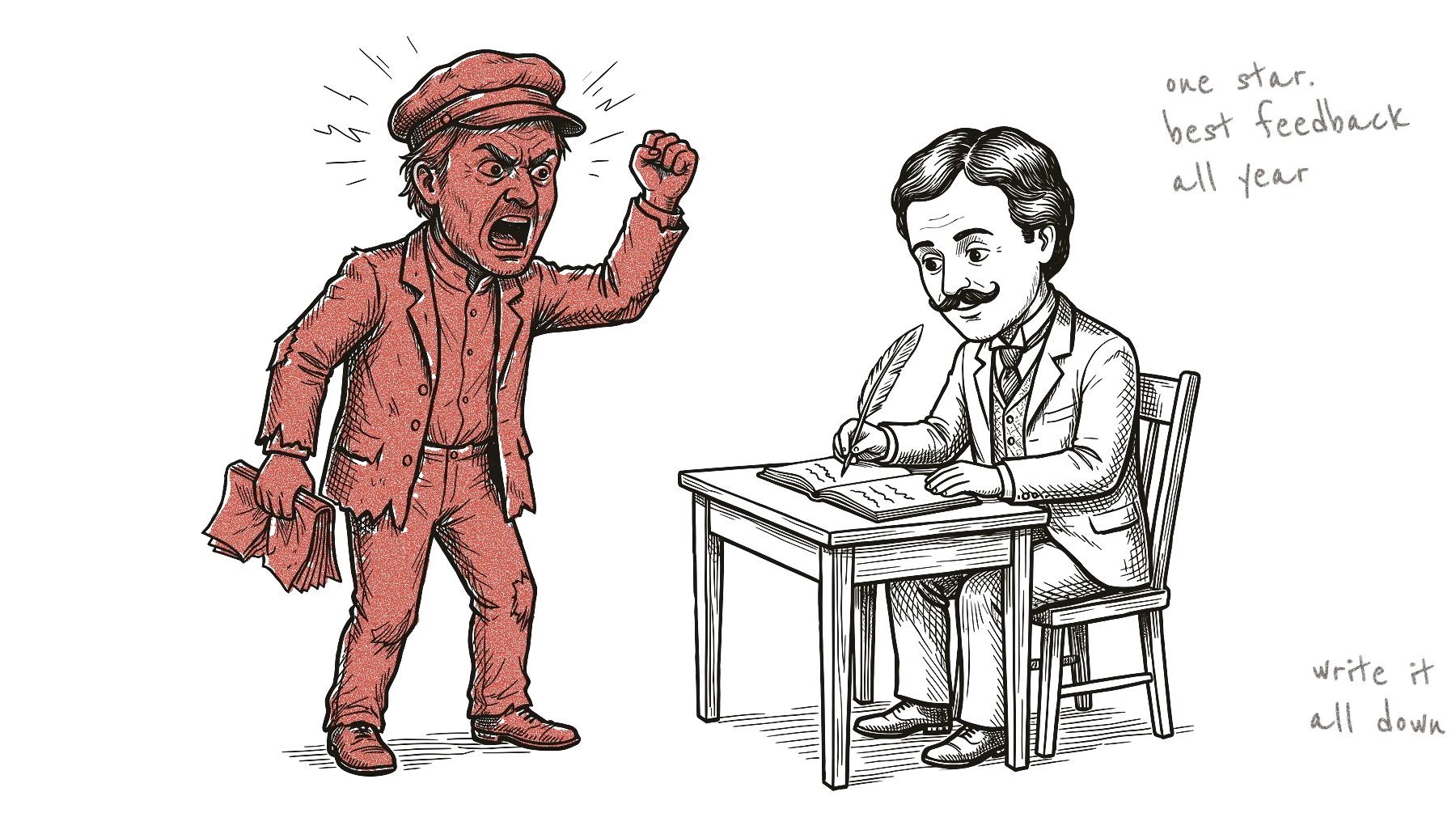
You check your reviews in the morning, coffee in hand. Twelve nice ones. And one new review with a single star, written in capital letters, by someone who seems to want you personally to suffer.
Guess which one you think about for the rest of the day.
That’s normal, and psychologists have studied it. A well-known 2001 paper is even called “Bad Is Stronger Than Good”. Its authors looked at many studies and concluded that bad feedback hits people harder than good feedback. So no, you’re probably not too sensitive. You’re reacting the way most people do.
It took me a while to understand this: the angry reviewer is doing you a favour, just very rudely.
One star for the print. Did they even read the book?
Outside of SaaSolution, I publish books, and I’ve had my share of one-star reviews. They’re often about one thing, for example the print quality. My first reaction was always the same: fine, print is part of the product, and if it wasn’t perfect, take a star off. But why not three stars, or at least two? Did they even read the book?
My guess now: these people were disappointed, and they wanted to be heard. A one-star review is often a shout, not a measurement.
The numbers fit that picture. In a 2007 study, researchers asked a group of students to rate the same music CD. Over 90 percent gave it between two and four stars. On Amazon, more than 60 percent of the reviews for that same CD were either one star or five. The people in the middle mostly don’t write reviews. The ones who write are the delighted and the furious.
So before you panic: a one-star review is loud, and most of your customers don’t feel that way. But loud doesn’t mean wrong. The angry person often found something real, and that’s where it gets useful.
Books or software, it works the same way.
Your hater found the spot you never tested
While you build a product, you use it the way you imagined it: you know where to click and which button not to press. You test it again and again from inside your own head and polish things nobody else will ever notice. I call it the perfection bubble.
Then you let it out into the world, and, if you’re lucky, lots of people use it. They use it on old phones and in a hurry, for jobs you never thought of. Suddenly your product has sides you didn’t know existed, and some of them hurt.
The happy customers usually won’t tell you about those sides, because they found a way that works for them and moved on. The angry one stepped right on the sore spot and is now pointing at it, in capital letters.
“Your most unhappy customers are your greatest source of learning.”
Bill Gates, Business @ the Speed of Thought, 1999
Normal feedback says “maybe make the button a bit bigger”. A hater says “I wasted my whole evening and I want my money back”. The second one tells you what people will not forgive: lost time and lost money.
Don’t fight back. Help.
A furious review reads like a personal attack, and that feeling is the hard part. The natural reaction is to fight back or to ignore it, and either way you waste a good complaint.
Instead, I wait until I’m calm, then reach out and try to help. Reviews aren’t the only place people complain. With my books, the angry comment often shows up under one of my ads on Instagram or Facebook. Then I write to the person directly and right away offer a full refund, or a new copy if theirs was faulty, whatever fixes it at that moment. Nobody should walk away feeling cheated.
Where you can’t write to people directly, reply right under the review. In the App Store you reply in App Store Connect, on Google Play in the Play Console, and on Google Maps in your Google Business Profile. If the person also wrote to you by email, answer there too.
I leave out any defence, any “actually, the content is great”. A reply can be this short:
“I’m sorry the print came out badly, that’s annoying. Could you send me a photo at [your email]? I’ll send you a new copy.”
So far it has gone well every time: nobody has said no to the offer, and the people I wrote to seemed glad not to be left alone with their problem. Some even changed their review for the better. It may go differently for you.
The research is more careful than I am, but it points the same way:
- Replying changes how people review. A 2017 study looked at hotels that started replying to their reviews. Afterwards, they got slightly better ratings and 12 percent more reviews. They also got “fewer but longer negative reviews”: less shouting, more detail you can use.
- Many platforms let reviewers update their review. Apple writes that when you respond to an App Store review, “the reviewer is notified and has the option to update their review.” Google Play also notifies the reviewer and shows you who changed their rating after your reply.
- A few bad reviews can even help. A wall of five stars can look too good to be true. Researchers at Northwestern University in the US looked at online shops. People were most likely to buy at an average rating between 4.0 and 4.7. Closer to a perfect 5.0, they bought less.
One thing I wouldn’t promise you: that the person whose problem you fixed will love you more than before. The research on that is mixed. Help them because it’s right and because you learn from it.
What to do with the next one-star review
- Don’t answer right away. Wait until the sting is gone, whether that takes an hour or a night.
- Find the sore spot. Ignore the tone and the capital letters. Write down in one sentence what actually went wrong for this person.
- Answer like a person. Write to them directly if you can, otherwise reply under the review. Say sorry for what went wrong and offer one concrete thing: a replacement, a full refund, a fix, or a short guide. Don’t defend yourself.
- Keep a list. Collect the sore spots from every angry review in one place. When the same one shows up three times, it has stopped being bad luck and become your next job.
- Fix it, then tell them. When the fix is live, add it to your reply under the review (“Update: this is fixed in version 2.3”). In my experience, that’s when a review sometimes changes.
”AI slop!” The hater who hates how you made it
A second kind of hater is angry about how you made the thing, and right now that mostly means artificial intelligence. Put a picture made with AI in an ad, and the comments fill up with “AI slop”: cheap, careless stuff made by a machine.
Those comments taught me something too. People seem angriest when an AI picture pretends to be a real photo, and once they notice, they stop trusting the rest. So the sore spot here is pretending. I no longer use AI to fake anything that looks real, like a photo of a product or a person.
Instead, I give the AI a clear style and a method, so the result doesn’t feel careless. Every picture on this blog is made that way, and I’m not hiding it:
- The style is an old patent drawing from around 1900. Those drawings are free to use, and I give a few of them to the AI as examples.
- An AI image tool from Google draws the scene in black ink.
- A small program adds one colour, slightly off the lines on purpose, the way people once coloured prints by hand, plus a few pencil notes in the margin.
- I look at every picture and throw out the ones that don’t work.
AI does most of the work. My part is deciding how it should look before anyone presses the button.
If you use AI in your product or your ads, the same rules help: don’t let it pretend to be something real, say openly where you used it, and give it a style that is clearly yours. When someone still writes “AI slop” under your post, a short, open reply works better than a fight, for example: “Yes, this picture is made with AI, and I say so. Here’s how we make them.”
The fear behind the anger
Some of the anger about AI has nothing to do with pictures: people are afraid for their jobs, and I think that fear deserves a fair answer.
Most of us need our jobs to pay the rent. And for many people, a job is more than money: it’s how they show what they can do. I think that’s especially true in design and art. Imagine you studied design and spent years getting good at it, and now you can’t find work, partly because of tools like the ones I use. Your anger makes sense, and “just find another job” doesn’t answer it.
Designers solve problems for the rest of us every day. Now people like me hand some of that work to AI, and times are hard for many of them. I don’t have good advice for someone who lost work this way, but I won’t wave it away.
I’d like my projects to earn enough to pay designers and illustrators for the next ones. At the start you rarely have the money, because an illustrator for a whole book and all the rounds of changes cost a lot. It’s a wish more than a moral way out, and I know it gets harder to keep once everything runs smoothly and the AI’s results are good.
Your happy customers keep you going. Your haters, rude as they are, point at what to fix next, whether that’s a bad print or an AI picture that pretends to be a photo. Thank God for both.
Sources
- Roy F. Baumeister, Ellen Bratslavsky, Catrin Finkenauer, Kathleen D. Vohs, “Bad Is Stronger Than Good”, Review of General Psychology, 2001
- Nan Hu, Paul A. Pavlou, Jennifer Zhang, “Why do Online Product Reviews have a J-shaped Distribution?”, working paper, 2007; Nan Hu, Jie Zhang, Paul A. Pavlou, “Overcoming the J-shaped distribution of product reviews”, Communications of the ACM, 2009
- Davide Proserpio, Georgios Zervas, “Online Reputation Management: Estimating the Impact of Management Responses on Consumer Reviews”, Marketing Science, 2017
- Apple, “Ratings, reviews, and responses” (developer.apple.com); Google Play Console Help, “View and analyze your app’s ratings and reviews”; Google Business Profile Help on replying to reviews (all read on 23 October 2026)
- Spiegel Research Center, Northwestern University, “How Online Reviews Influence Sales” (findings first published 2017)
- Celso Augusto de Matos, Jorge Luiz Henrique, Carlos Alberto Vargas Rossi, “Service Recovery Paradox: A Meta-Analysis”, Journal of Service Research, 2007
- Bill Gates, Business @ the Speed of Thought, 1999 (quote as cited by the Journal of Accountancy, January 2006)