For makers By Rade Kolbas26 October 20266 min read
Date your ideabefore you marry it.
Around 2014 I bought wool in different colours to map a product idea on a wall. It never shipped, and today I think the company was right. What I'd do differently: keep my distance, and solve one problem at a time.
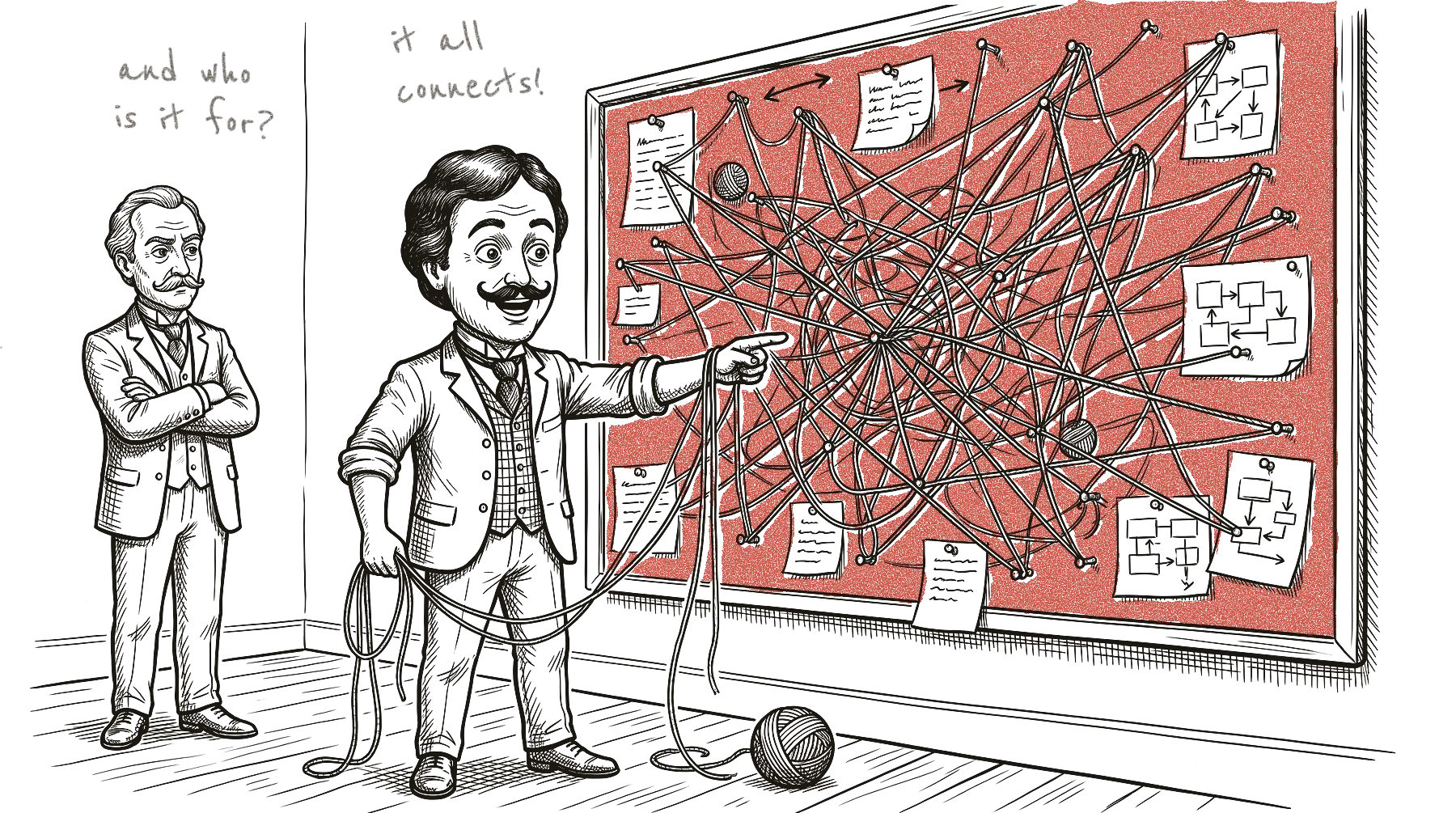
There’s a scene in the TV comedy “It’s Always Sunny in Philadelphia” where Charlie stands in front of a wall of papers joined by string. He is sure he has found a huge conspiracy that only he can see. Around 2014, I was that man: I bought wool in different colours to show what was in my head, stretched across a wall and even in three dimensions. To my colleagues I must have looked like Charlie, and when I think back to that time, I still feel a bit like him.
If you are about to spend months on your big idea, this story is for you. The steps I’d take today are near the end.
As a product manager, my job was to translate people’s problems into software. This was one of the most complex projects I ever worked on, and there wasn’t really a problem behind it. The brief was more like: let’s make something cool, something that could make money, something people could use.
How I tried to solve everything at once
I ended up trying to solve all the problems of the world with one piece of software. It was about how people work together, and about how a company is organised. Above all it was about decisions. A project waits for a manager to decide. That manager waits for another decision, and that one needs research first, or an expert’s approval, or more information. I wanted every one of these links from the real world in the software, connected, hence the wool.
Then a very experienced product manager, who knew the Lean Startup approach well (building a product in small steps and testing each one with real users), came in to help me. He challenged the whole thing with two questions: who exactly is this for, and what exactly is the problem we are solving?
I remember how frustrated I was, because the answers seemed so obvious to me that I didn’t even want to talk about them. In my head, this thing just had to happen.
Everyone loved it, which proved nothing
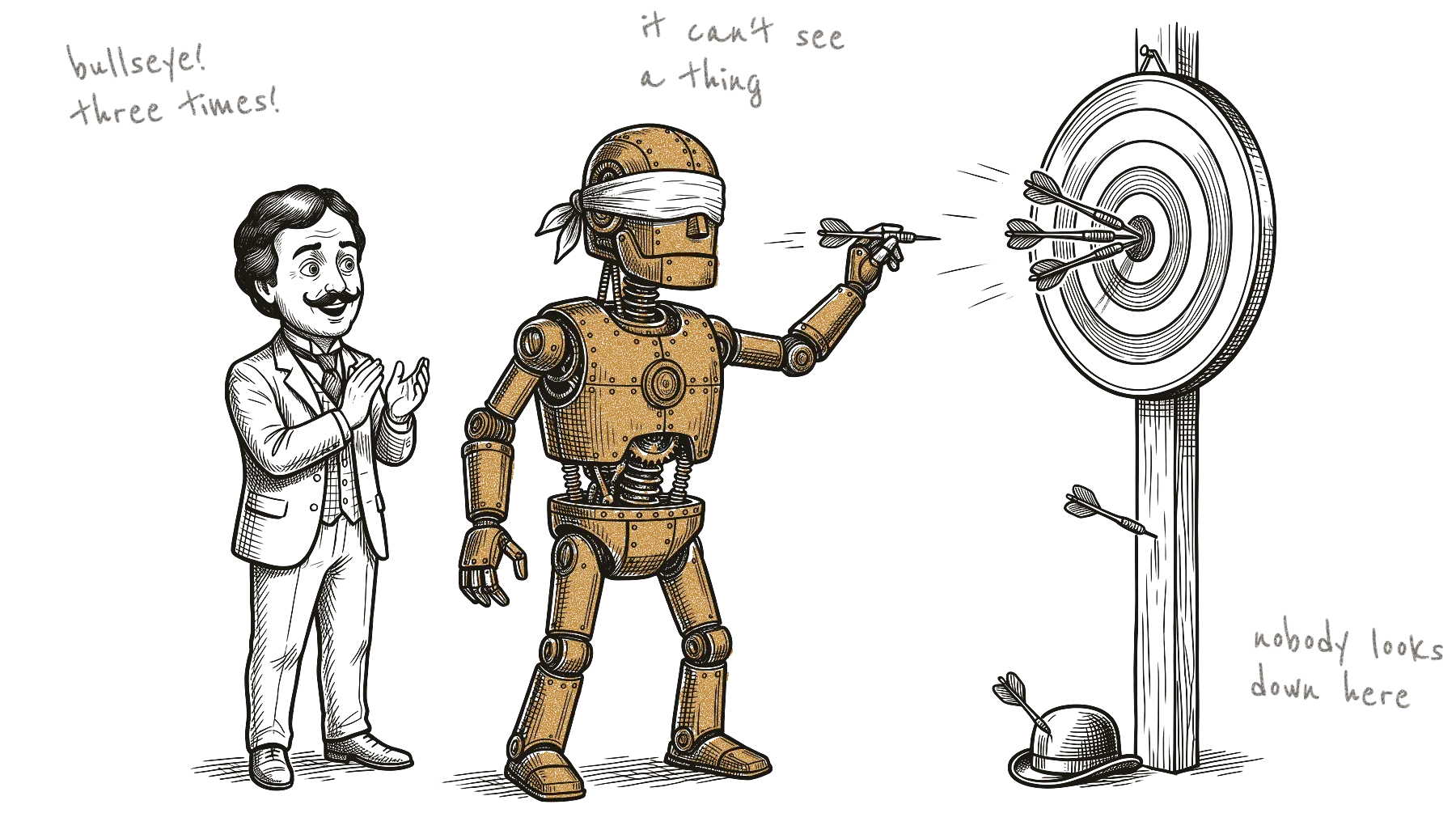
I designed a lot of screens and pitched the idea often, and every time I had the feeling that everyone was excited. People found it cool and wanted to use it. Some even came to me and asked when it would be ready, because they needed something like this. I took all of that as proof that the world needed exactly this product.
I think psychology has two names for what was going on. One is the frequency illusion: once something is on your mind, you notice it everywhere, although it was always there. The other is confirmation bias: you look for, and read, evidence in a way that favours what you already believe.
The illusion made my problem look like it was everywhere, and the bias turned every friendly nod into proof that my solution was the right one.
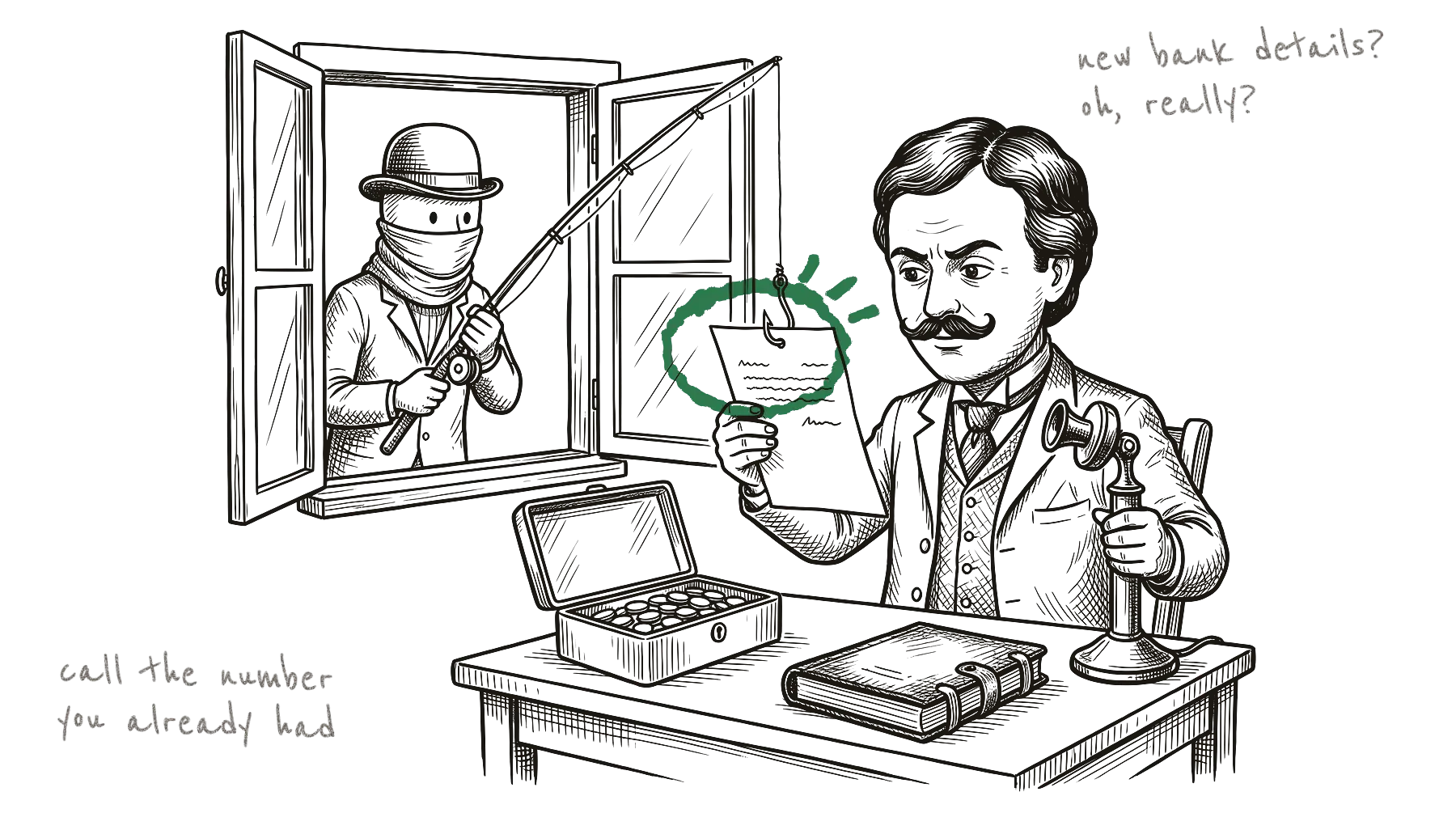
A compliment in a meeting costs nothing, and neither does “When will it be ready?”: nobody had to change how they worked or move a budget to say it.
It never happened, and the company was right
The project never got built. I learned a huge amount from it, but I was disappointed that the company didn’t invest and never gave it a chance to fly.
Today, years later, I would make the same call as the company did. It was a big project, so big that investing in it meant a strong commitment, and nobody knew where we would end up. I had never done proper research on who else was out there, who I was competing with, whose budget I wanted, or how much money could come in. How to roll it out was just as unclear.
Looking back, it was a kind of self-fulfilment, my ego project. I wanted to prove to myself that I could create something great, that I was talented and knew what I was doing. It had good, creative ideas in it, but no good business case: no clear answer to who would pay for it, and why.
I never gave the project a chance to fail. I didn’t dare to think that I might be wrong, because I thought I had played it through a thousand times in my head.
Instagram started as something else
Ideas that work often look different at the end than at the start, and Instagram is one of them. By 2010, Kevin Systrom had built Burbn, an app for checking in at places, making plans, collecting points and sharing photos, and even he thought it was too much.
“It felt cluttered, and overrun with features.”
Kevin Systrom on Burbn, quoted by TechCrunch, 2010
So he and Mike Krieger cut almost everything except photos, comments and likes. Instagram launched on 6 October 2010 and had about a million users by late December. In 2012 Facebook agreed to buy it for about a billion dollars in cash and shares.
The founders dated Burbn rather than marrying it: they noticed what people used and let the rest go.
How I’d date an idea today
Uri Levine, a co-founder of the navigation app Waze, called his 2023 book “Fall in Love with the Problem, Not the Solution”. I’d add a step before the falling in love: date it first.
- Keep some inner distance. It’s the most important thing I learned, because if I’m on fire for a project, I also burn out. So I try it out, and I take it easy.
- Solve one problem at a time. Only when one problem is solved, and I can see that the solution works, do I move on to the next.
- Start small. In the Lean Startup, the small version is the “minimum viable product”. Eric Ries describes it as the one that lets you learn the most about your customers “with the least effort”.
- Give the idea a chance to fail. Allow yourself to think that you might be wrong, which I never did.
- Count what people give, not what they say. Praise and “When will it be ready?” are free. Someone who pays, switches from the tool they use now, or gives you an hour to try it tells you much more.
The new trap: you can build everything now
I think this matters even more today than it did in 2014. With AI coding tools you can build a lot very quickly, and when you can build everything, you tend to build everything. Every feature brings responsibility with it. It has to be maintained, it can break, and it depends on other features, so the complexity keeps growing.
I saw this in a desktop app for AI agents, assistants that do tasks on their own, which I found cool at first, though it ran badly. Big updates came almost every day, with long lists of fixed bugs. Inside there was every setting you could imagine: font size, colours, contrast, anything.
Germans call this an “eierlegende Wollmilchsau”, an egg-laying wool-milk-sow that’s supposed to do everything. I uninstalled the app after a short time. It had become too complex for me to know what I could do with it, and the flood of fixes made me uneasy.
That’s a story for another post. For now: start small, keep your passion in check, and don’t get too carried away. Your idea might turn out to be a Burbn, and that’s fine, as long as you’re still willing to see it.
Sources
- “It’s Always Sunny in Philadelphia”, season 4, episode 10, “Sweet Dee Has a Heart Attack”, FX, 30 October 2008
- Arnold Zwicky, Language Log, 7 August 2005, on the “frequency illusion” (also known as the Baader-Meinhof phenomenon); Ben Zimmer, “‘Frequency illusion’ in the OED”, Language Log, 19 March 2019
- Raymond S. Nickerson, “Confirmation Bias: A Ubiquitous Phenomenon in Many Guises”, Review of General Psychology, 1998
- TechCrunch, “A Pivotal Pivot”, 8 November 2010, quoting Kevin Systrom’s answer on Quora; TechCrunch on Instagram’s first million users, 21 December 2010; Facebook, announcement of the Instagram acquisition, 9 April 2012
- Eric Ries, “Minimum Viable Product: a guide”, Startup Lessons Learned, 3 August 2009; Eric Ries, “The Lean Startup”, Crown Business, 2011
- Uri Levine, “Fall in Love with the Problem, Not the Solution: A Handbook for Entrepreneurs”, 2023